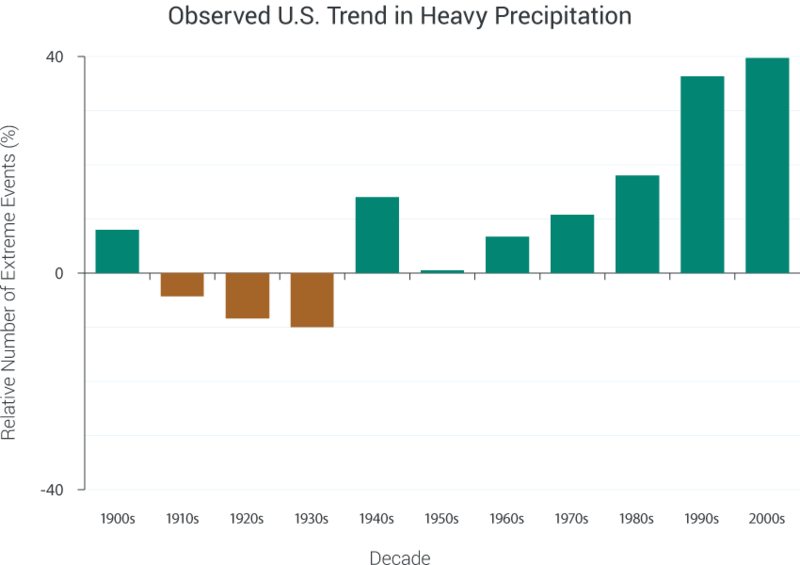
That is, if one day, a rainstorm forms, more water may fall to the ground, sometimes in a very short period of time.
Since pre-industrial days the earth has already warmed around 1.1 degrees Centigrade (15.2 degrees Fahrenheit) due to greenhouse gas emissions from the burning of fossil fuels and deforestation.
More rain can often be a boon to drinking water and agriculture, as the American West, struggling with a record drought, knows perfectly well.
In Houston, researchers have discovered that converting open space to paved parking lots and residential developments helped exacerbate flooding following Hurricane Harvey in 2017.
Consider a heavy rainy storm that has in the past appeared only once a decade on average.
Recent surveys have shown an increase in hourly rainfall extremes across parts of the United States, Europe, Australia and Asia.
In California, parts of Interstate 1 plunged into the Pacific Ocean this year, after heavy rains provoked rides of mud and debris.
Correction: Central Park, NY has just observed 3.15 inches of rain in one hour, from 8:51 pm to 9:51 pm.
— NWS New York NY (@NWSNewYorkNY) September 2, 2021


